
Photography algorithms play a central role in how digital images are captured, processed, and displayed.
They transform raw sensor data into detailed, color-accurate photographs.
Modern cameras and smartphones rely heavily on computational techniques. Understanding these algorithms helps you evaluate image quality.
The Foundations of Digital Image Processing
Digital photography depends on mathematical operations applied to pixel data. Each image is represented as a grid of intensity values across color channels.
Algorithms manipulate these values to improve clarity and visual balance. This processing happens in real time inside cameras and editing software.
At the core of image processing are concepts like sampling, quantization, and interpolation.
Sampling determines how frequently light information is recorded across a sensor. Quantization converts analog light signals into discrete digital values.
Research in digital image processing
This is extensively documented in academic references such as Digital Image Processing by Rafael C. Gonzalez and Richard E. Woods.
Standards bodies like the International Organization for Standardization (ISO) also define measurement methods for digital camera performance.
These foundations ensure that algorithmic decisions are measurable and reproducible.
Without these principles, resolution and color correction would lack consistency.
Resolution Enhancement Algorithms
Resolution describes the level of detail an image can display. It is commonly measured in pixels or spatial frequency response.
Higher resolution allows finer details to be distinguished. However, resolution depends on both hardware and software processing.
Camera sensors capture a fixed number of pixels. Algorithms such as demosaicing reconstruct full-color images from sensor patterns like the Bayer filter.
Demosaicing methods estimate missing color information at each pixel location. Advanced techniques reduce artifacts while preserving fine detail.
Super-resolution algorithms
These methods combine multiple frames or use machine learning models to predict high-frequency details.
Multi-frame super-resolution is widely used in smartphones according to research published in IEEE journals.
It aligns and merges sequential exposures to reduce noise and enhance clarity.
Edge enhancement
Sharpening filters, including unsharp masking, increase contrast along boundaries.
This improves perceived sharpness without adding true detail.
Excessive sharpening, however, introduces halos and noise amplification.
Standards such as ISO 12233 define methods for measuring spatial resolution in digital cameras.
Color Correction and White Balance Algorithms
Color correction ensures that images represent scenes with realistic tones. Lighting conditions strongly influence recorded color values.
Different light sources emit different spectral distributions. Algorithms compensate for these variations to maintain accuracy.
White balance algorithms estimate the scene’s illumination color. They adjust red, green, and blue channels to neutralize color casts.
Common approaches include gray-world assumptions and reference-based calibration.
More advanced systems use scene recognition to refine adjustments.
Color correction matrices
Most consumer devices convert captured data into sRGB or Adobe RGB formats.
These transformations are based on color science models defined by the International Commission on Illumination (CIE).
Accurate matrix calibration
Tone mapping algorithms also influence perceived color quality. They compress high dynamic range data into displayable ranges.
This affects brightness gradients and saturation levels. Improper tone mapping can distort natural skin tones and shadows.
Research from imaging science communities highlights the importance of perceptual color models.
Noise Reduction and Detail Preservation
Noise is a random variation in pixel intensity. It increases in low-light conditions or at high ISO settings.
Noise reduction algorithms aim to smooth unwanted variation. However, excessive smoothing removes fine detail.
Traditional noise reduction uses spatial filtering. Gaussian blur and median filters reduce pixel fluctuations.
These methods are computationally simple but may soften textures. Balancing clarity and smoothness remains a key challenge.
Multi-frame noise reduction
Multiple exposures are aligned and averaged. This reduces random noise while preserving structural information.
It is especially effective in night photography modes. Machine learning approaches have recently improved performance.
Convolutional neural networks are trained on noisy and clean image pairs. They learn to distinguish noise patterns from true detail.
Evaluation remains essential
Metrics such as signal-to-noise ratio quantify algorithm effectiveness. Visual inspection complements numerical analysis.
Optimal results require tuning for specific shooting conditions. When you analyze image output, look closely at textured regions.
Fine patterns reveal whether algorithms oversmooth surfaces. Balanced processing maintains realism without visible grain.
The Role of Computational Photography
Computational photography integrates hardware and advanced algorithms. Smartphones increasingly rely on software-driven image formation.
Techniques such as HDR merging combine exposures for improved dynamic range.
This allows detail retention in both shadows and highlights.
HDR algorithms detect exposure differences across frames. They align images to prevent ghosting artifacts.
Weighted blending produces a balanced brightness distribution. Research from institutions like MIT Media Lab has explored these techniques extensively.
Portrait mode features
Stereo vision or dual-pixel autofocus systems measure distance. Background blur is then simulated through segmentation.
This creates shallow depth-of-field effects computationally. AI-based scene recognition further adjusts color and exposure parameters.
Neural networks classify scenes such as landscapes or indoor lighting. Processing pipelines adapt automatically to optimize rendering.
Understanding
Despite automation, understanding these mechanisms empowers you as a photographer.
Algorithmic decisions influence contrast, saturation, and detail. Manual overrides remain valuable for creative control.
Combining technical knowledge with artistic intent produces better outcomes.
Evaluating Algorithm Performance in Practice
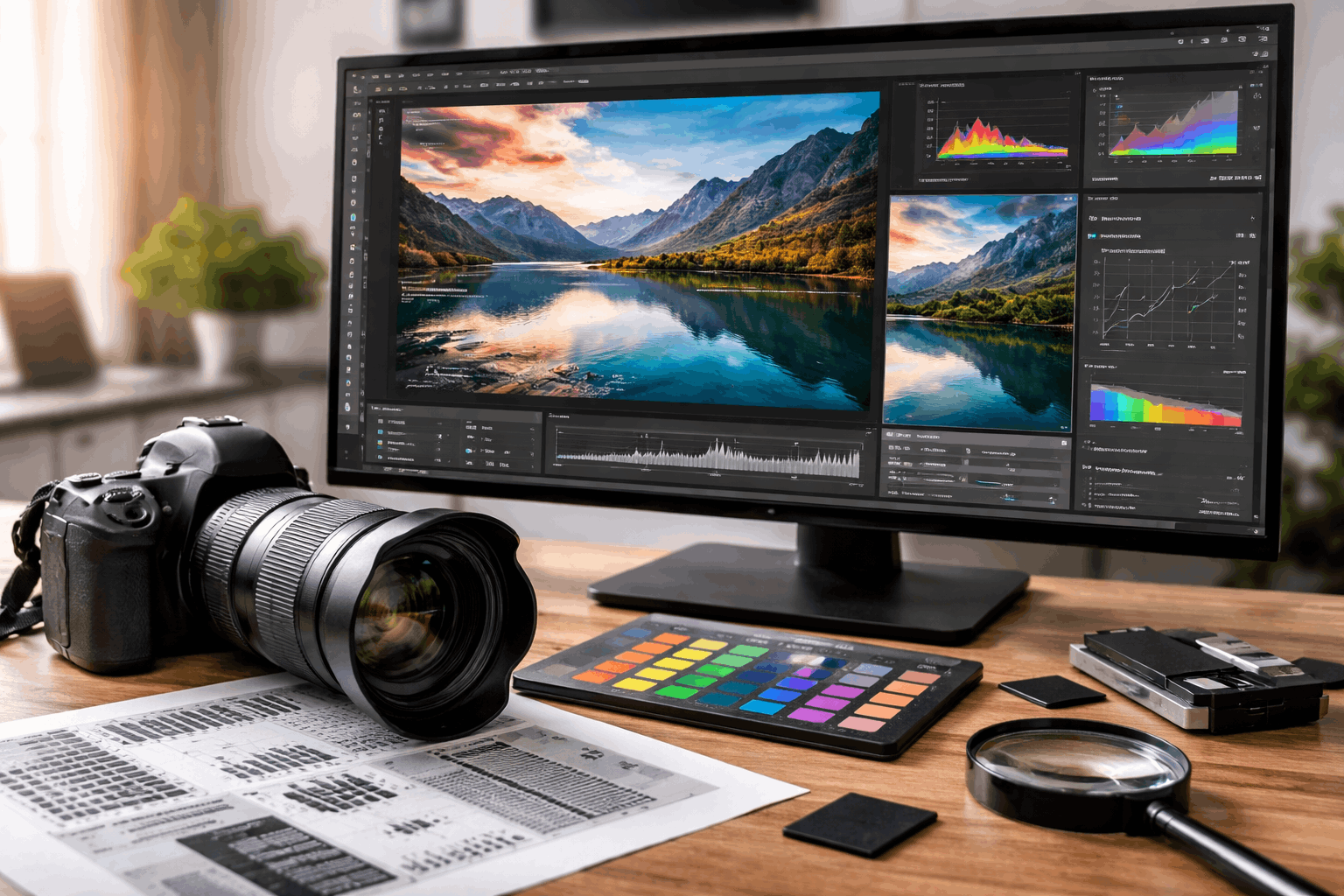
Objective evaluation requires controlled testing environments. Standardized charts measure resolution and color fidelity.
Laboratory lighting ensures repeatability. These methods provide comparable results across devices.
Organizations such as DXOMARK conduct standardized camera tests. They assess dynamic range, texture retention, and color accuracy.
Published methodologies reference internationally recognized standards. Independent testing improves transparency in performance claims.
Field testing also matters
Real-world scenes reveal limitations not visible in laboratory setups. Mixed lighting and motion stress algorithm robustness.
Practical use confirms whether processing enhances usability. When reviewing photography systems, focus on consistency.
Reliable algorithms produce stable results across varied conditions. Inconsistent rendering indicates unstable calibration.
Understanding measurement techniques
Understanding measurement techniques enables more informed comparisons. You can interpret specifications with greater clarity.
Marketing claims become easier to evaluate critically. Data-driven analysis strengthens purchasing decisions.
Conclusion
Photography algorithms shape every digital image you capture. Resolution enhancement and color correction rely on established scientific principles.
Standards and peer-reviewed research provide reliable benchmarks for evaluation.
When you understand these processes, you gain greater control over image quality and performance.