
Artificial intelligence now influences how music is created, distributed, and monetized across digital platforms.
Streaming-driven business models make the industry especially sensitive to technologies that can rapidly scale content production.
Algorithmic composition refers to systems that generate musical structures or audio using computational rules or machine learning.
What Algorithmic Composition Means Today
Algorithmic composition uses computational systems to generate melodies, harmonies, rhythms, or complete arrangements.
Modern AI systems often rely on machine learning models trained on large datasets to predict musical sequences statistically.
Research groups such as Google’s Magenta describe these systems as tools designed to augment, rather than replace, human creativity.
Industry debates increasingly focus on training data, licensing, and compensation rather than on whether AI can technically compose music.
From Research Projects to Commercial Tools
Early AI music experiments began as academic research exploring symbolic composition and probabilistic modeling.
Google’s Magenta project demonstrated interactive music models that assist composers through generative suggestions.
OpenAI’s Jukebox expanded this field by generating raw audio, including vocals, using deep neural networks trained on recordings.
These developments showed that algorithmic composition could move from MIDI-style note output to full audio synthesis.
How AI Systems Generate Music
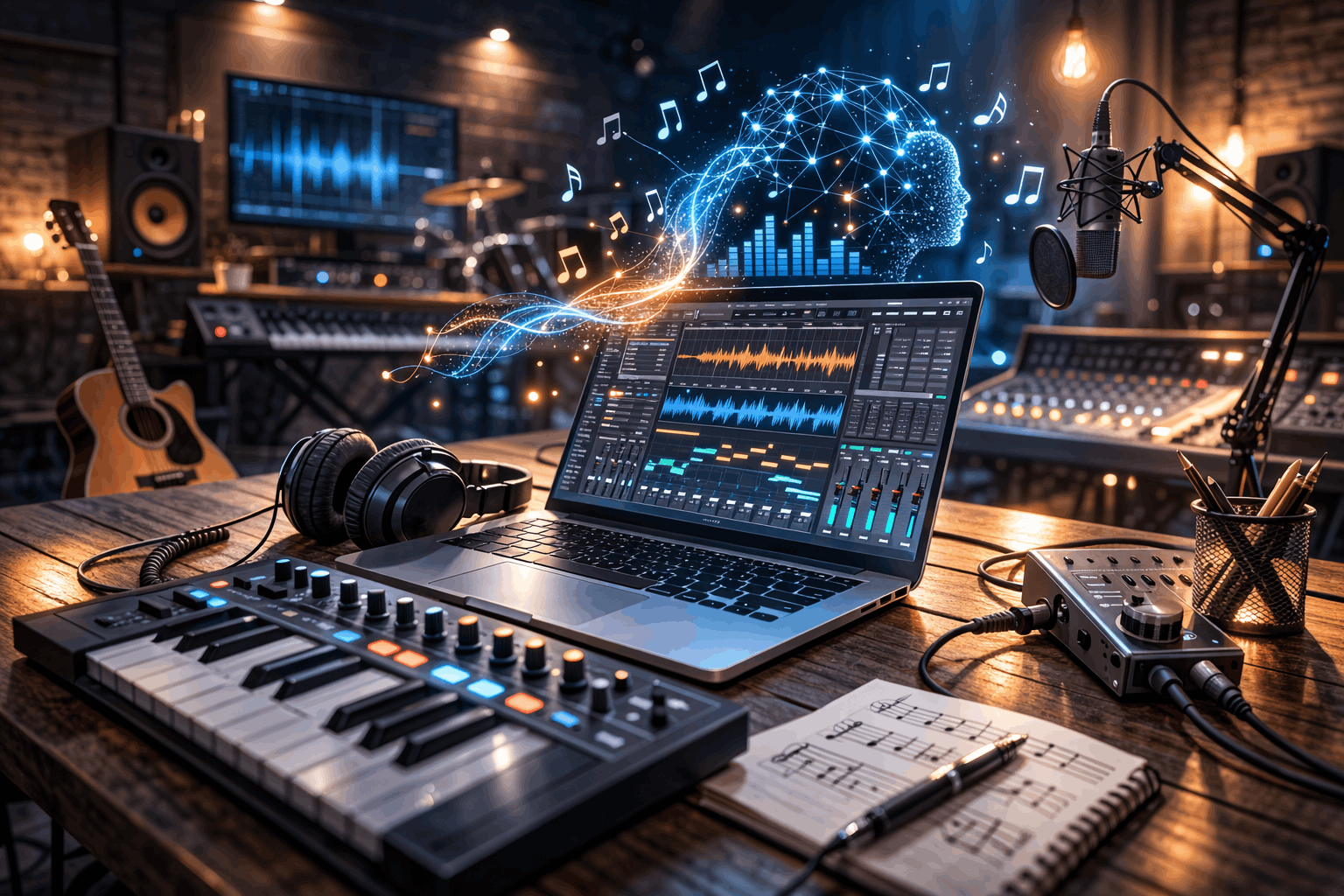
Many generative models learn statistical relationships between notes, chords, timbres, and structural patterns.
After training, these systems predict subsequent musical elements based on probability distributions learned from data.
Symbolic models generate note-level structures, while audio models directly synthesize waveform outputs.
This technical distinction matters because audio-level generation more closely resembles recorded performance and production.
Creative Implications for Musicians
For artists, AI tools can accelerate brainstorming and reduce creative block during early drafting stages.
Producers may use generative systems to experiment with arrangement variations or harmonic alternatives.
Some creators integrate AI outputs into hybrid workflows where human editing shapes the final artistic direction.
The U.S. Copyright Office emphasizes that meaningful human contribution remains central to authorship recognition.
Industry Economics and Production Workflows
Algorithmic composition lowers entry barriers for background scoring, advertising cues, and short-form content production.
Studios can use generative tools to create placeholder tracks during editing before commissioning finalized compositions.
This efficiency may reduce certain production costs while expanding overall content volume.
However, industry bodies such as IFPI warn that uncontrolled scaling could affect catalog value and revenue distribution.
Copyright and Human Authorship Standards
The U.S. Copyright Office has clarified that copyright protection requires human authorship.
Works containing AI-generated material must identify and describe the human contributions during registration.
Recent U.S. court decisions have reinforced that purely machine-generated works lack copyright protection.
This legal framework encourages positioning AI as an assistive tool rather than as an autonomous creator.
Training Data and Legal Disputes
Major record labels have filed lawsuits against AI music companies including Suno and Udio, according to Reuters reporting.
The lawsuits allege unauthorized use of copyrighted recordings in model training datasets.
These cases may shape future licensing norms for generative AI systems in the music sector.
Industry reports suggest that clearer consent-based data agreements could become standard practice.
Streaming Platforms and AI-Generated Content
Streaming platforms face operational challenges when AI tools enable mass uploads of generated tracks.
Deezer has publicly reported detecting significant volumes of fully AI-generated submissions on its service.
The company has described deploying AI-detection systems to tag such content and protect royalty distribution.
Reports in major media outlets highlight concerns about fraudulent streaming tied to AI-generated uploads.
Fraud, Manipulation, and Recommendation Systems
Algorithmic discovery systems depend on engagement metrics that can be distorted by artificial streaming activity.
High volumes of low-cost generated music increase the risk of manipulation within recommendation algorithms.
Fraudulent streams divert royalties from legitimate artists and distort market signals.
Platforms are responding with detection, tagging, and exclusion mechanisms to maintain ecosystem integrity.
Ethical and Cultural Questions
Beyond economics, algorithmic composition raises cultural questions about originality and artistic identity.
Because models learn patterns from existing works, debates continue over influence versus imitation.
Artists express concern about stylistic mimicry that may blur boundaries between homage and replication.
Policy discussions increasingly emphasize transparency about training data and attribution standards.
The Future of Algorithmic Composition
Generative music systems are likely to become embedded as assistive features within mainstream production software.
Industry stakeholders are pushing for licensing frameworks that balance innovation with creator compensation.
Detection technologies and provenance tracking may become standard components of streaming governance.
The long-term sustainability of AI in music depends on aligning technical progress with clear ethical and legal safeguards.
List of Algorithmic Composition AIs
Here’s a list of notable algorithmic composition and AI music tools — systems that use artificial intelligence to generate, assist, or transform musical material:
- 1. AIVA — Artificial Intelligence Virtual Artist
AIVA is an AI composer capable of generating original music in various styles, from classical and cinematic to rock and jazz. - 2. Soundraw
A music generation platform that produces customizable instrumental music based on user preferences such as genre, mood, and tempo. - 3. Boomy
An AI tool that quickly generates full songs with minimal input, ideal for creators who want instant tracks without deep technical knowledge. - 4. Suno AI
A generative music system that creates original tracks from text prompts, allowing customization of genre, instrumentation, and structure. - 5. Beatoven.ai
An AI music generator focused on royalty-free background music, useful for videos, games, and podcasts. - 6. Loudly AI Music Creator
A platform that generates music with varied rhythms and structures across modern genres. - 7. Music Muse (or AI Music Generator)
Tools like Music Muse convert text descriptions into complete songs and arrangements. - 8. Canva’s AI Music Generator
An accessible text-to-music tool inside Canva that generates tracks tailored to user projects. - 9. Amadeus Code
AI songwriting assistant designed to help generate chord progressions and melodic ideas (listed in industry tool overviews). - 10. SongR, Fadr, WavTool, Landr
Additional AI platforms that help with song generation, melody ideas, mixing, and mastering.
Conclusion: Innovation Within Boundaries
Algorithmic composition represents both a technological milestone and a regulatory challenge for the music industry.
Reliable research and reporting from institutions such as the U.S. Copyright Office, IFPI, Reuters, and major technology.
Human authorship standards, training transparency, and platform oversight will determine how responsibly the technology evolves.